Could your team ship three products in four months?
Every pipeline is different. The fastest way to know if PIPA fits yours is to walk through a real product decision together.
 Try FIOS®
With FIOS® behind the process, Rivalz launched three products in four months—on a fraction of the R&D budget an established CPG company would typically spend for a comparable outcome.
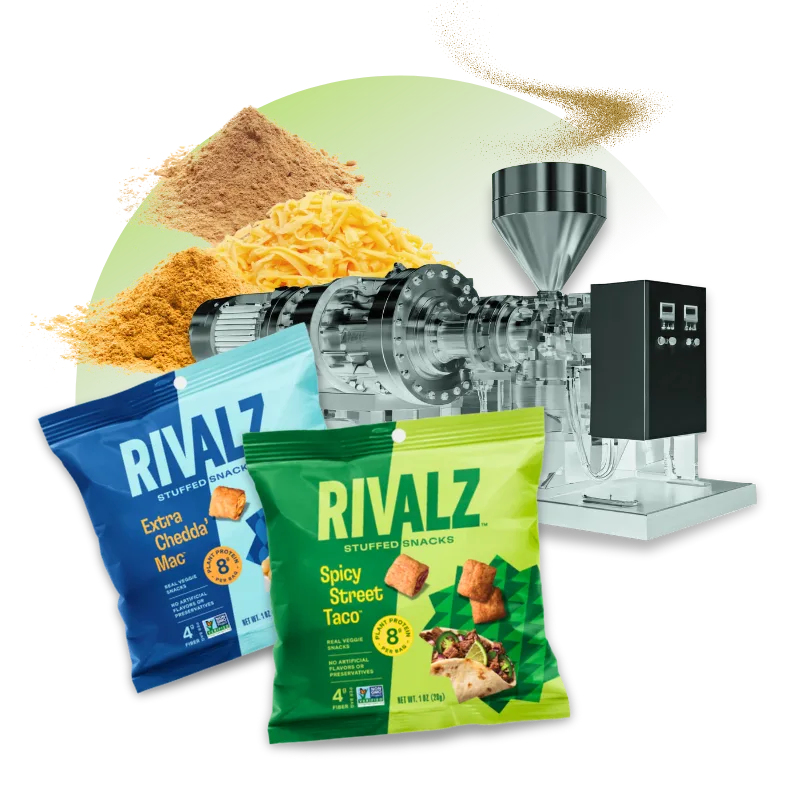
The modern challenger-brand playbook in snacks is to move faster than incumbents. Faster iteration on consumer trends. Faster launch of new SKUs. Faster response to retail feedback. But faster product development traditionally means more R&D headcount, more lab runs, more manufacturing pilots — all of which are capital-intensive.
Rivalz needed to develop multiple SKUs at speed with a lean team. That meant replacing trial-and-error pilot runs with predictive formulation, and compressing the time from concept to shelf-ready product from years to months.
The bet was explicit: if AI-driven product development can predict what works before it’s made, a small team with the right platform can outrun large teams with legacy workflows.
Rivalz uses FIOS® to simulate thousands of formulation variants per product concept. Multicomponent modeling handles the binder-plus-particulates structure of healthy snacks. Digital twins predict process behavior at extrusion and baking. Sensory, nutrition, and cost are optimized together, with regulatory constraints (Nutri-Score targets, labeling rules) baked into the search space.
What emerges from that simulation is a small set of high-probability winners — formulations that have already cleared the modeling hurdle before anyone turns on an extruder. The physical lab work that remains is confirmation, not exploration.
Net effect: Rivalz’s R&D cycles compressed by over 95% versus traditional CPG product development. Three products shipped in four months. Materials and formulation spend dropped 32% because failed pilot runs mostly don’t happen.
The Rivalz story is bigger than faster product launches. It signals a new economic model for challenger brands, where AI takes on work that once demanded dozens of costly pilot runs. Formulation cycles that used to require six-figure budgets can now run in simulation. Timelines that once took months can now shrink to weeks. That’s why more teams are moving to this new model.