
On October 13, 2025, the AI Institute for Next Generation Food Systems (AIFS) at University of California, Davis convened researchers, industry leaders, technologists and policy-makers for the AI for Food Product Development Symposium. The event underscored that, when applied thoughtfully across the food value chain, artificial intelligence can accelerate innovation and bring product development into a new era of responsiveness and possibility.
Expert perspectives: AI’s impact on food product development
As Harold Schmitz, Ph.D., AIFS Advisory Board Member, highlighted during the symposium, this moment represents a kind of “Sputnik moment for food innovation” signaling just how quickly AI is reshaping opportunities across the sector.
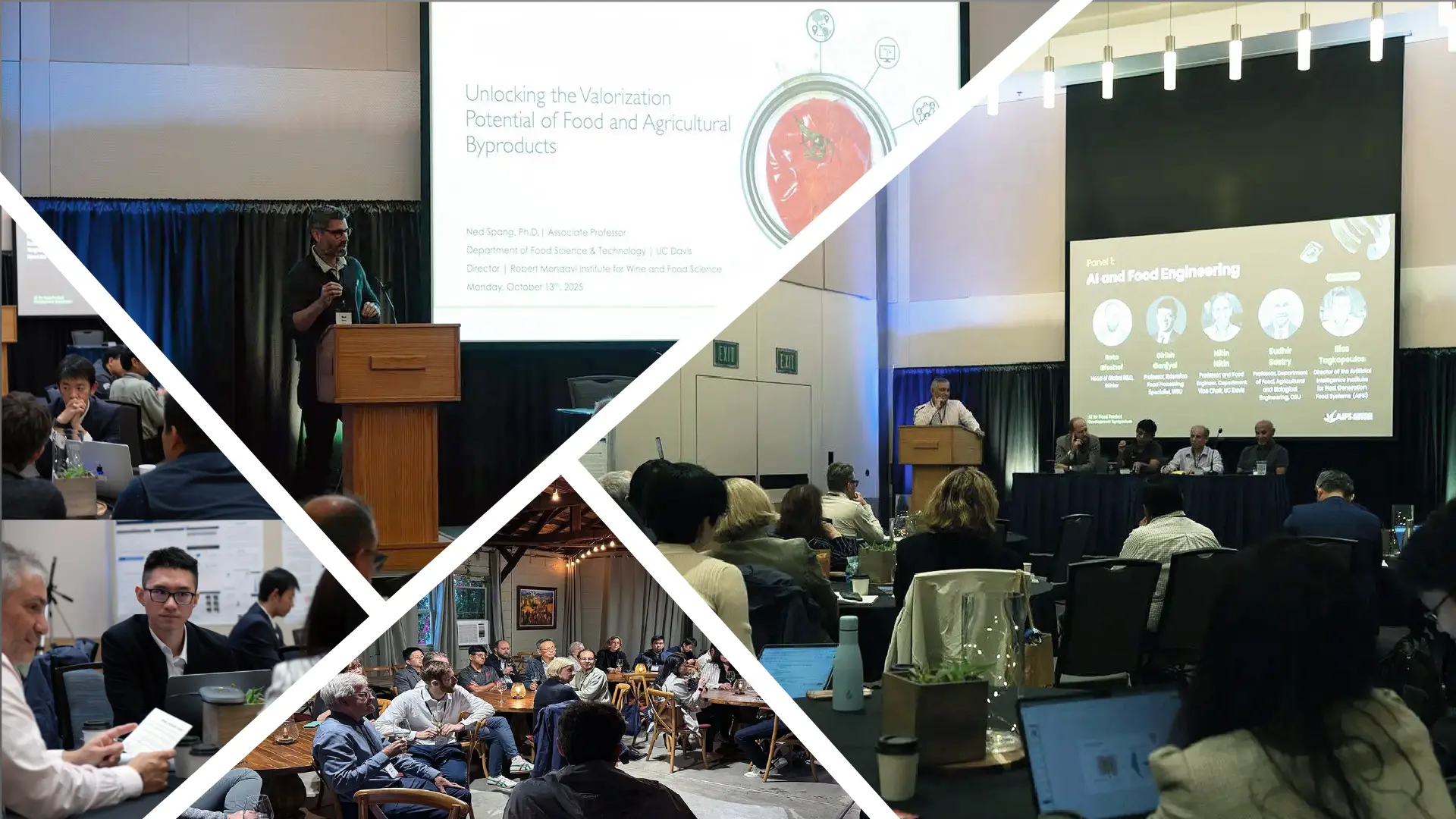
Image credit: AI Institute for Next Generation Food Systems (AIFS)
AI is beginning to reshape multiple stages of food product development. Discussions highlighted the growing use of AI in formulation and ingredient discovery, where digital tools are helping teams explore possibilities more efficiently. Automation and robotics in product prototyping also featured prominently, pointing to new ways companies can streamline early development work.
Speakers underscored how advances in sensory science and consumer preference modeling are giving researchers a clearer view of how products may be received. Machine learning’s role in strengthening quality control and meeting regulatory expectations further illustrated AI’s expanding influence. A recurring theme was the need to move innovations beyond the pilot phase and into full commercialization. Alongside these technical directions, the symposium also emphasized responsible AI practices and the importance of equity as the field continues to evolve.
Key challenges: Why it’s not plug-and-play
While the potential is clear, practical barriers were also highlighted.
- Data complexity & quality: Data quality, investment and access to sufficiently large datasets are major obstacles in applying AI effectively in food.
- Talent & resource allocation: There is a need for stronger collaboration between food scientists and AI specialists, along with increased investment in AI talent.
- Integration over silos: Fragmented data and disconnected disciplines limit the ability to fully leverage AI across the value chain.
- Business fit & change management: Successful adoption requires embedding AI into workflows rather than treating it as a standalone technology project.
A quote from AIFS Director, Ilias Tagkopoulos, Ph.D reinforced this challenge:
“If people think that we have AI, we can throw all the data that we have right now, and the AI will come up with an answer — this is not working. Not for food.”
Looking ahead: What’s next?
The discussions pointed toward several future directions:
- Open data & shared infrastructure: There is a need to strengthen data infrastructure and reduce fragmentation across the food system.
- Focus on full value-chain integration: A strong call to action on integrating AI across the entire system from crop production, formulation through production and go-to-market.
- Responsible, ethical AI adoption: Ethical, inclusive and sustainable AI practices will play a central role in future efforts.
- Commercial-scale deployment: A key focus is moving from pilot applications to commercially scalable solutions.
The AI for Food Product Development Symposium set a strategic tone for how the food industry may evolve over the coming years. For companies, researchers, and technologists looking to stay ahead, the question is no longer whether AI will shape food innovation — but how to integrate it into research, development, and decision-making in ways that deliver real value for people and the planet.
PIPA’s FIOS brings the data, science, and workflows of food product development into one system — helping companies move faster, spend less, and build better products for consumers. Contact us to learn more or explore current and previous partnerships.