Mars, Inc., the global food and pet care company, is actively advancing its ingredient innovation efforts by applying artificial intelligence within its R&D programs.
In a recent feature by FoodNavigator, Mars outlined its own approach to using AI to develop new food ingredient ingredients, especially in areas such as plant-based bioactives, while keeping scientific responsibility and human judgment firmly at the center. A key enabler of this work is Mars’ collaboration with PIPA, through its AI research assistant, LEAP™.
The takeaway is clear: AI can help R&D teams to focus their effort on the right ingredient candidates earlier, saving time and supporting evidence-driven decision-making.
AI as a support layer for scientific judgment
Rather than replacing traditional research methods, Mars applies AI to support its scientists in navigating the growing volume and complexity of scientific evidence. AI is applied to organize scientific literature and data, helping researchers compare and prioritize potential research directions that may warrant further investigation.
Importantly, all AI-generated insights are treated as hypotheses – not conclusions – and are evaluated experimentally alongside expert judgment to ensure scientific rigor. As Darren Logan, Vice President of Research at the Mars Advanced Research Institute and Global Food Safety Center, told Flora Southey at FoodNavigator:
“We’ve tested this between random choices, expert choices, and AI-assisted choices. What we see is that in some cases, AI significantly improves hit rate.”
LEAP™: Built for evidence-based research
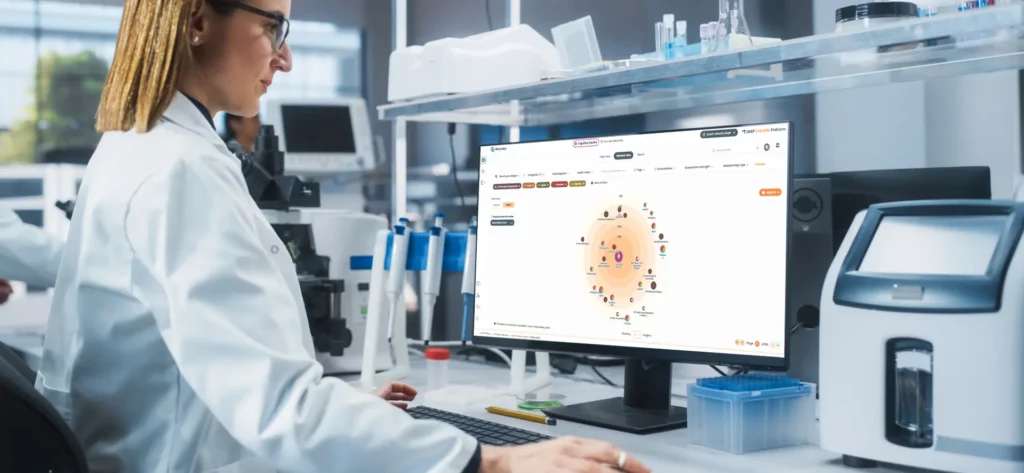
Unlike general-purpose Generative AI tools, LEAP™ is built upon more than 300 AI/ML and food science pipelines and operates on robust, curated data, where context, traceability, and source transparency are essential.
By organizing scientific knowledge into structured representations, LEAP™ helps Science and Technology teams to:
- identify and prioritise ingredient candidates based on existing research,
- map relationships between ingredients, biological mechanisms, and outcomes,
- review supporting evidence with clear visibility into underlying sources.
This makes it particularly suited to research environments where interpretability and scientific rigor are critical.
From evidence to R&D impact
As expectations for functional and sustainable foods grow, Mars’ approach shows how AI can be applied pragmatically in large-scale CPG R&D. With an evidence-first, Science & Technology-purpose-built platform like LEAP™, teams can focus experimental work on the most promising directions, reducing uncertainty and accelerating early-stage research.